





.jpg664dba822d672.jpg)

Mức lương
17 - 24 triệu
Tìm việc an toàn cùng TopCV

TopCV sẽ gửi phản hồi qua email bạn đã nhập trong vòng tối đa 24h.
Liên hệ hotline nếu sau 24h bạn chưa nhận được phản hồi qua email:
1900 068 889 | Nhánh 2 (Giờ hành chính)
Hoặc email trực tiếp cho TopCV tại địa chỉ: hotro@topcv.vn
Xin cảm ơn!



About the Role
CECCS is recruiting a Junior Research Programmer to support research and project development in energy modelling, scientific computing, environmental data analysis, and climate-development research.
This role is designed for candidates who already have a solid technical foundation in programming, data processing, computational modelling, optimization, forecasting, GIS, remote sensing, applied machine learning, or scientific computing — and who want to apply these skills to serious research problems in energy, environment, climate change, and development policy.
Compared with the Research Programmer Trainee position, this role requires stronger technical ownership, higher independence, and greater ability to connect data, models, assumptions, documentation, and research outputs. The Junior Research Programmer is expected not only to support workflows, but also to help develop, improve, validate, and document them for real project use.
Candidates do not need to already be climate or energy specialists. However, they should be able to learn complex domain knowledge quickly and work with interdisciplinary research questions that involve technical, economic, policy, and environmental dimensions.
At CECCS, the work is practical, data-driven, and research-oriented. Outputs are expected to be reliable, reproducible, and suitable for research deliverables, policy-facing outputs, technical reports, and potentially publication-oriented work.
This position is especially suitable for candidates who want to build a serious technical research profile and may later pursue advanced research roles, graduate study, scholarships, technical policy analysis, research management, or international academic and policy research pathways.
Why Work With Us
CECCS works on applied research problems at the intersection of environment, energy transition, climate change, and development. Our work is connected to real technical, economic, policy, and social challenges in Vietnam and ASEAN.
Research areas include:
As a Junior Research Programmer, you will have opportunities to:
CECCS has operated for 10 years and has worked with ministries, public institutions, universities, and research partners. The center is also expanding collaborations with international scholars, universities, and climate-related research and investment organizations.
This is an opportunity to use technical skills not only to complete assigned tasks, but to help build research tools, evidence, and analytical capacity for meaningful climate, energy, and development problems.
Research Environment
CECCS provides a supportive but demanding research environment. The Junior Research Programmer is expected to work with meaningful independence while still collaborating closely with senior researchers and project teams.
The working style is built around:
This role is not designed for candidates who only want to execute narrow technical tasks. It is best suited for candidates who want to grow into stronger research programmers, technical analysts, research associates, or project-oriented researchers.
Tools and Research Infrastructure
To support effective research work, CECCS provides access to suitable tools and infrastructure depending on project needs.
These may include:
These resources are provided primarily as work-enabling tools. They also create a valuable environment for candidates who want to develop advanced technical, analytical, and research capacity.
Research Exposure and Publication Opportunities
Depending on project needs and individual performance, Junior Research Programmers may have opportunities to contribute to:
Publication is not guaranteed. However, strong contributors may gain meaningful exposure to academic-quality research, technical writing, model documentation, peer review, and publication-oriented research processes.
This experience may be especially valuable for candidates considering graduate study, research careers, scholarship applications, technical policy research, or international academic pathways.
Specialty Tracks
Junior Research Programmers may contribute to one or more of the following tracks depending on skills, background, and project needs.
1. Energy Systems, Optimization & Numerical Modelling
This track focuses on power systems, renewable integration, operations research, scenario modelling, resource planning, and numerical workflows for energy-climate questions.
Relevant areas include:
2. Remote Sensing, GIS & Environmental Data
This track focuses on satellite data, geospatial analysis, land use, climate and environmental datasets, map-based evidence, and spatial validation workflows.
Relevant areas include:
3. Machine Learning, Forecasting & Scientific Computing
This track focuses on transfer learning, time-series forecasting, applied machine learning, Python/R/Julia pipelines, reproducible notebooks, and model validation.
Relevant areas include:
4. Research and Project Development
This track focuses on turning research ideas into structured project concepts, technical workflows, research plans, and fundable or implementable initiatives.
Relevant areas include:
Job Description
1. Data Collection, Processing & Analysis
The Junior Research Programmer will collect, clean, validate, structure, and document datasets from multiple sources, including reports, APIs, satellite and geospatial sources, academic papers, public databases, and project-specific materials.
Key responsibilities include:
2. Research Model Development
The Junior Research Programmer will support the development, adaptation, execution, validation, and documentation of computational workflows for applied research projects.
Key responsibilities include:
3. Research and Project Development
The Junior Research Programmer will also support early-stage research and project development activities, especially where technical scoping, data assessment, and analytical design are required.
Key responsibilities include:
4. Reporting, Visualization & Documentation
The Junior Research Programmer will help convert computational outputs into research deliverables that can be understood by technical and non-technical audiences.
Key responsibilities include:
Note: This role is for candidates who want to build reliable research outputs and computational workflows, not just finish assigned tasks.
1. Candidate Background
We welcome applications from candidates with a Bachelor’s degree, or equivalent demonstrated ability, in fields such as:
Minimum experience:
This experience does not need to come only from a formal full-time job. Strong academic projects, research experience, coding portfolios, technical coursework, or competition projects may also be considered.
2. Technical Skills
Required:
Preferred:
Candidates do not need to master all these areas. However, they should show evidence of technical maturity, independent learning ability, and readiness to work with complex research problems.
3. English Requirement
Candidates should be proficient in English, especially for reading technical documents, academic papers, project materials, and research reports.
An IELTS score around 7.0 or equivalent is preferred. However, practical ability to read, understand, and work with English research materials is the most important requirement.
4. Personal Qualities
We are looking for candidates who are:
This role is best suited for candidates who want to grow into stronger technical researchers, research programmers, project development analysts, research associates, or graduate-level researchers.
Role Fit
This position is especially suitable for candidates who are technically capable, analytically strong, willing to learn by doing, and motivated by real projects rather than classroom-style assignments only.
The strongest candidates are likely to be those who:
Applicants should clearly express their strengths, goals, technical skills, and relevant project experience in their CV or cover letter so that we can assess fit properly.
Application Note
When applying, please include a CV and, if possible, a short cover letter or statement explaining:
Candidates are encouraged to be specific. We value clear evidence of technical ability, seriousness, curiosity, and willingness to learn.
Dưới đây là những dấu hiệu của các tổ chức, cá nhân tuyển dụng không minh bạch:
Tìm hiểu thêm kinh nghiệm phòng tránh lừa đảo tại đây


Cơ hội ứng tuyển việc làm với đãi ngộ hấp dẫn tại các công ty hàng đầu
Trước sự phát triển vượt bậc của nền kinh tế, rất nhiều ngành nghề trở nên khan hiếm nhân lực hoặc thiếu nhân lực giỏi. Vì vậy, hầu hết các trường Đại học đều liên kết với các công ty, doanh nghiệp, cơ quan để tạo cơ hội cho các bạn sinh viên được học tập, rèn luyện bản thân và làm quen với môi trường làm việc từ sớm. Trong danh sách việc làm trên đây, TopCV mang đến cho bạn những cơ hội việc làm tại những môi trường làm việc năng động, chuyên nghiệp.
Vậy tại sao nên tìm việc làm tại TopCV?
Việc làm Chất lượng
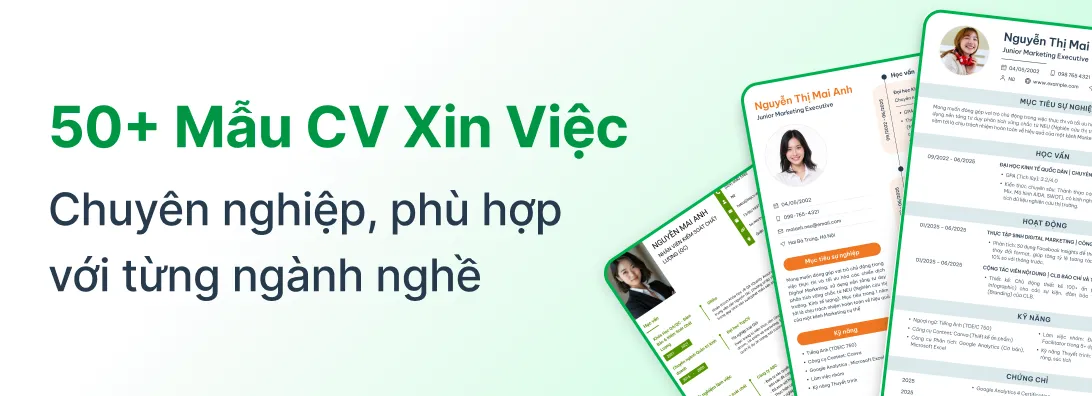
Công cụ viết CV đẹp Miễn phí
Hỗ trợ Người tìm việc
Tại TopCV, bạn có thể tìm thấy những tin tuyển dụng việc làm với mức lương vô cùng hấp dẫn. Những nhà tuyển dụng kết nối với TopCV đều là những công ty lớn tại Việt Nam, nơi bạn có thể làm việc trong một môi trường chuyên nghiệp, năng động, trẻ trung. TopCV là nền tảng tuyển dụng công nghệ cao giúp các nhà tuyển dụng và ứng viên kết nối với nhau. Nhanh tay tạo CV để ứng tuyển vào các vị trí việc làm mới nhất hấp dẫn tại việc làm mới nhất tại Hà Nội, việc làm mới nhất tại TP.HCM ở TopCV, bạn sẽ tìm thấy những việc làm mới nhất với mức lương tốt nhất!
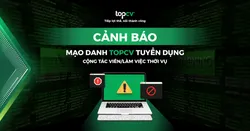
Trước tình trạng gia tăng các hình thức lừa đảo việc làm trên internet được các cơ quan chức năng cảnh báo, TopCV xin lưu ý bạn một số dấu hiệu lừa đảo việc làm như sau:
Thông tin thiếu minh bạch
Hứa hẹn lương cao bất thường
Yêu cầu nạp tiền, mua hàng trên app/website
Yêu cầu nộp phí phỏng vấn, phí giữ chỗ, phí đồng phục,...











Chức năng ứng tuyển công việc trên tài khoản của bạn đang tạm thời bị khóa.
Vui lòng liên hệ hotline 1900 068 889 | Nhánh 2 hoặc email hotro@topcv.vn để được hỗ trợ.
Số năm kinh nghiệm của bạn chưa phù hợp với yêu cầu của vị trí này.
Bạn có muốn tiếp tục ứng tuyển?
Xác nhận thông tin ứng tuyển nhanh
Bạn đã lựa chọn ứng tuyển nhanh cho ({{ selected_job_ids.length }}) vị trí tuyển dụng
Thêm lựa chọn - thêm cơ hội
Ứng tuyển: {{ selected_job_ids.length }} tin tuyển dụng Xem danh sách
Tin tuyển dụng bạn đang xem đã hết hạn ứng tuyển
TopCV lựa chọn ra ({{ selected_job_ids.length }}) tin tuyển dụng tương tự với tin bạn đang xem, bạn có thể lựa chọn những tin phù hợp nhất dể ứng tuyển nhanh một lần duy nhất!
Thêm lựa chọn - thêm cơ hội
TopCV đề xuất tin tuyển dụng tương tự, hãy chọn các tin phù hợp và click ứng tuyển để tăng cơ hội việc làm.
Vui lòng bật chia sẻ vị trí để Toppy Ai gợi ý những cơ hội việc làm phù hợp nhất dành riêng cho bạn
Hướng dẫn bật chia sẻ vị trí để Toppy Ai gợi ý những cơ hội việc làm phù hợp nhất dành riêng cho bạn
Giá trị đơn hàng trước thuế: 40.000 VNĐ
Thuế GTGT (8%): 4.000 VNĐ
Tổng giá trị đơn hàng: 50.000 VNĐ
Thanh toán thành công
Cảm ơn bạn đã tin tưởng và sử dụng dịch vụ của topcv.vnNếu bạn đã thanh toán nhưng dịch vụ chưa được kích hoạt, tiền sẽ được hoàn về tài khoản của bạn sau 1-2 ngày làm việc.
Trường hợp bạn không nhận được tiền hoàn sau thời gian trên, vui lòng liên hệ để được hỗ
trợ.
Hotline: 1900 068 889 | Nhánh 2 (Giờ hành chính) | Email: hotro@topcv.vn